
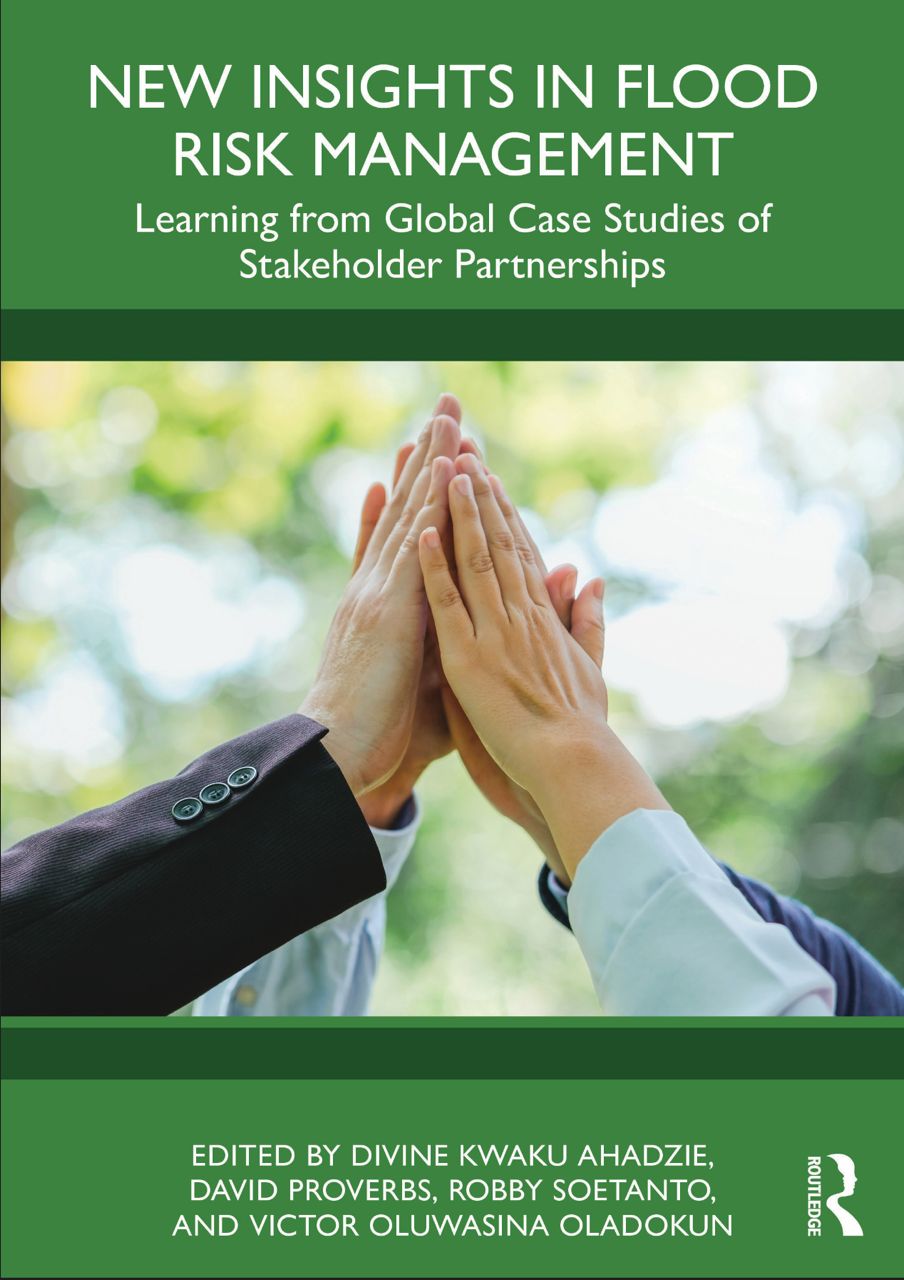
Professor Divine Kwaku Ahadzie of the Centre for Settlements Studies at the College of Art and Built Environment, KNUST, has launched a new book titled New Insights in Flood Risk Management: Learning from Global Case Studies of Stakeholder Partnerships, a publication that seeks to advance global understanding of collaborative approaches to flood resilience.
The book explores case studies from both the Global South and Global North, highlighting innovative frameworks and practical lessons for building resilient communities in the face of increasing flood disasters.
Edited by Professor Ahadzie in collaboration with Professor David Proverbs of De Montfort University, Dr. Robby Soetanto of Loughborough University and Professor Victor Oluwasina Oladokun of the University of Ibadan, the book reflects years of international research and engagement in flood risk management.
The publication builds on growing global conversations around resilience, particularly within the framework of the Sendai Framework for Disaster Risk Reduction, which promotes stronger community participation in disaster preparedness and response.
Speaking on the publication, Professor Ahadzie explained that the inspiration for the book emerged from years of research into community flood risk management and a defining conversation with Togbe Adamah of the Some Traditional Area in Agbozume, who advocated stronger collaboration between public and private actors in addressing flood disasters.
According to him, that local insight became the foundation for a broader academic inquiry into how partnerships can be scaled globally to improve flood resilience.
“The book is looking at new insights into partnership and trying to learn from global case studies, and we expect that as a learning experience, we’ll begin to understand that flood risk management has both the government dimension and the community and public dimension,” he said.
Professor Ahadzie noted that while governments remain central to flood management through land use regulation, infrastructure development and policy implementation, communities must also take a more active role in mitigating flood risks.
He stressed that empowering communities through awareness and local action could significantly strengthen government interventions and reduce the devastating impact of floods.
“What we want the public to pick from this book is that we should understand that, of course, when it comes to flooding, the major responsibility lies with the government because it is inherent to land use and infrastructure and other things.
“But then it is equally also true that as citizens we need to play a very strong or critical role and that is where we need to begin to understand how communities can also orient themselves through orientation to be able to be part of flood risk management,” he stated.
A major contribution of the book, according to Professor Ahadzie, is the introduction of practical frameworks designed to guide collaboration between communities and institutions in flood response.
He explained that one such model, the CHAMPION Framework, encourages the active involvement of chiefs, assembly members and Members of Parliament in leading community-level flood resilience efforts.
Another, the GovernsFlash Framework, seeks to strengthen coordination between the National Disaster Management Organisation (NADMO), local government authorities and traditional leaders.
“These are frameworks we have developed, all of which are featured in the book and which we hope to showcase for public education and the promotion of knowledge,” he noted.
Professor Ahadzie expressed optimism that the global examples documented in the book would inspire communities in Ghana and beyond to adopt practical, collaborative measures in addressing flood challenges.
“And so I really think that from the global studies that have been showcased in the book, it will be useful for the public to read and begin to understand that it is possible and that there are good examples around the world that we can learn from to begin to start something small from our communities,” he added.