
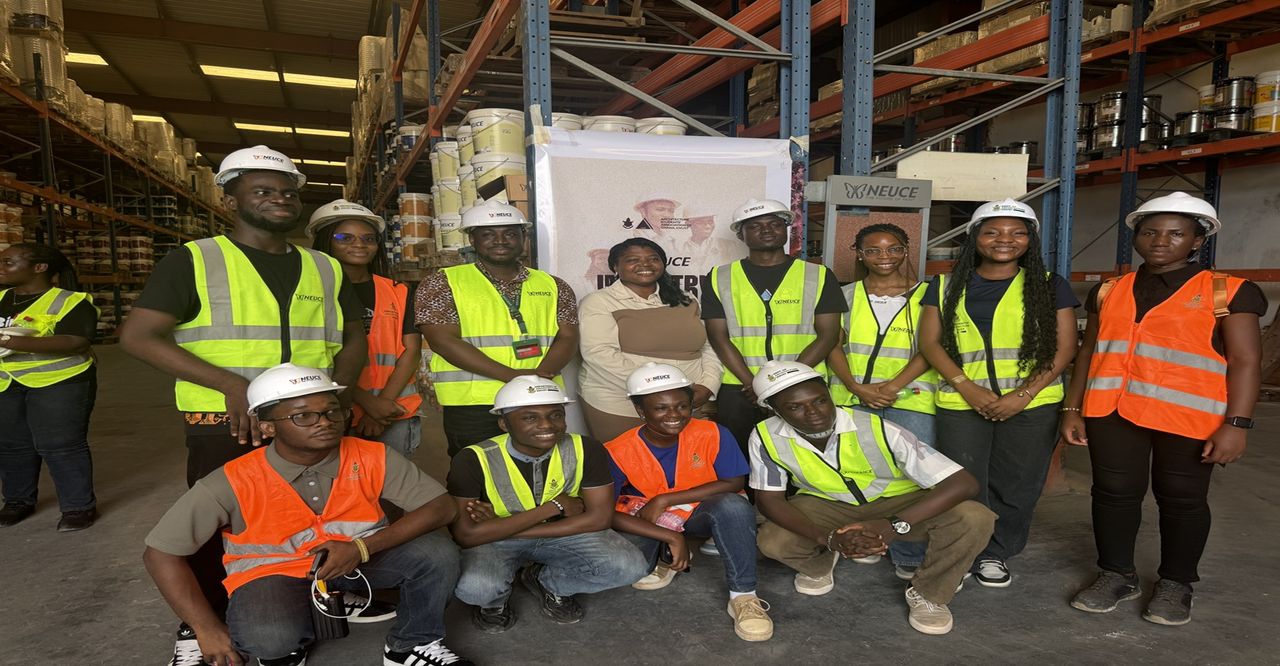
The Architecture Students Association of Ghana (ASAG) has organized an industrial field trip for students of the Department of Architecture to NEUCE Paints Ghana Limited.
The educational tour formed part of the Association’s commitment to complement classroom instruction with industry-based experiences, giving students firsthand exposure to modern paint manufacturing processes, quality control systems, surface finishing technologies and sustainable industrial practices.
The students were welcomed by officials of NEUCE Paints, who provided an overview of the company’s history, operations and commitment to quality production before guiding participants through the various sections of the factory.
To ensure effective engagement, the students were divided into three groups for the tour, allowing them to closely observe the different stages of paint production and testing.
A major highlight of the visit was the Quality Control Laboratory, where students observed product testing processes including viscosity measurement, drying time analysis, density checks and colour consistency assessments. The laboratory also demonstrated how new products are developed and how customer complaints are investigated as part of quality assurance measures.
The students also witnessed paint tinting processes, where colourless base paints are mixed with colorants to produce specific finishes, while company officials explained that one litre of paint can typically cover between 10 and 14 square metres per coat.
At the production section, participants observed the preparation of raw materials such as resin, pigments, calcium carbonate, additives and anti-foam agents, as well as the batching, filling and packaging processes.
Students were introduced to the distinctions between oil-based and water-based paints and the different packaging systems used for each.
The tour also exposed students to the company’s dust extraction systems and sustainable waste management practices, including the recycling of textured paint materials and the treatment and reuse of water through its water treatment plant.
Beyond production processes, students were introduced to various finishing systems including primers, acrylic paints, decorative textured coatings, stucco, micro-cement, waterproofing systems and self-levelling epoxy flooring, broadening their appreciation of material application in contemporary architectural practice.